
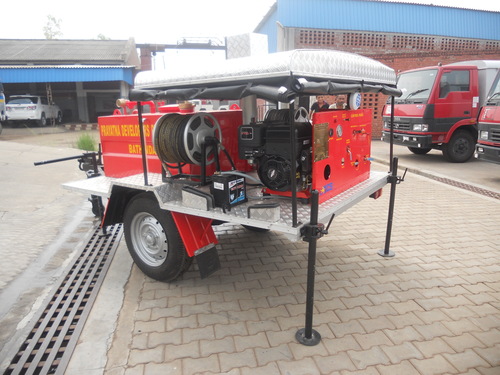
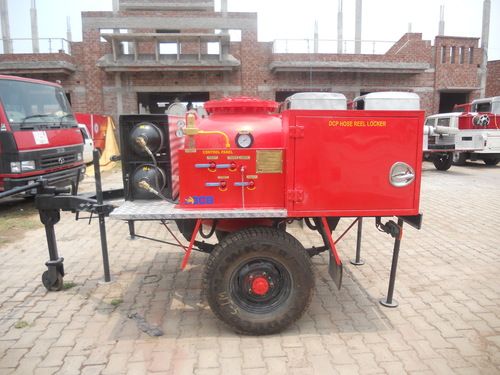
Trailer Mounted Water Mist System
Product Details:
- Operating Pressure 100 to 150 bar
- Working Temperature 0C to 50C
- Installation Type Mobile, trailer mounted
- Control Type Manual & automatic control panel
- Fire Extinguisher Type Water mist system
- Coverage Area Up to 500 sq.m.
- Voltage 220240V
- Click to view more
X
Trailer Mounted Water Mist System Price And Quantity
- 1 Unit
Trailer Mounted Water Mist System Product Specifications
- 100 L/min
- 65 mm hose (main discharge)
- 100 to 150 bar
- A, B, C
- 0C to 50C
- 250-1000 L water storage
- Up to 500 sq.m.
- A+
- 220240V
- Mobile, trailer mounted
- High-pressure water mist
- Rectangular tank on robust trailer
- Manual & automatic control panel
- Standard fire hose coupling
- Trailer mounted, rapid deployment, low water usage, advanced mist nozzles
- Trailer mounted
- 100-150 bar
- Water mist system
- Anti-corrosive powder coated finish
- Quick-response firefighting for industrial, commercial, and remote locations
- High-velocity mist nozzle
- Electric driven high-pressure pump
- NFPA/EN certified
- LED indicators for operational status
- Top fill with water inlet
- Approx. 450 kg (empty)
- 30 m standard length
- 2500 mm x 1200 mm x 1400 mm
- Heavy-duty stainless steel
- 12V battery for control panel
- Galvanized steel
- Up to 15 m
- Pneumatic tyres for all terrain
- Towable by light-duty vehicle
- Automatic pressure relief valve
Trailer Mounted Water Mist System Trade Information
- Telegraphic Transfer (T/T), Cheque
- 500-1000 Unit Per Year
- 40-45 Days
- Australia, North America, South America, Eastern Europe, Middle East, Africa, Central America, Western Europe, Asia
- All India
- ISO 9001:2008
Product Description
We have gathered a huge customer base in this domain by manufacturing, exporting and supplying the pristine grade Trailer Mounted Water Mist System. Manufactured with high tech techniques, this system is further tested by a crew of dedicated professionals to ensure safety and quality standard. Offered system is widely demanded in emergency fire caught at oil and refineries industries. More, the provided Trailer Mounted Water Mist System can be purchased from us at economical prices.
Key Points:
- No sound vibration
- Rust resistance
- Longer service life
- Unmatched performance
TECHNICAL PARAMETERS
| Engine | Reputed Briggs & Stratton make of 13 to 14 H.P. |
| Pump | Imported High Pressure Plunger Pump having discharge rate 35 to 40 LPM @ 100 Bar pressure. |
| Hose Reel with Gun | 60 Meter, DIN / EN approved High Pressure Hose with fully imported Gun having Fog, Jet & Foam spray arrangement. |
| Water Tank | 300 to 450 Litres capacity M.O.C.- GRP / S.S. 304 |
| Foam Tank | 50 Litres capacity |
| Optional | Additional 60 meter High Pressure Hose with gun |
| Trailer Chassis | Permissible total weight capacity of 1500 Kg. |
Advanced Water Mist Technology
Utilizing high-pressure mist nozzles, this system maximizes fire suppression efficacy with minimal water usage. The fine mist achieves rapid cooling and extinguishing, while reducing collateral water damage and increasing safety in diverse environments.
Robust Trailer-Mounted Design
Built on a galvanized steel frame with heavy-duty stainless steel tank, the trailers pneumatic tyres ensure excellent mobility across all types of terrain. Its compact footprint allows for efficient towing by light-duty vehicles, creating a versatile mobile firefighting unit.
Reliable Control & Safety Features
Engineered for responsive operation with manual and automatic control panel options, the unit includes LED status indication and a 12V battery backup for the control panel. Safety is prioritized with an automatic pressure relief valve and top-fill refilling method.
FAQs of Trailer Mounted Water Mist System:
Q: How does the Trailer Mounted Water Mist System operate during emergencies?
A: The system uses an electric-driven high-pressure pump to deliver water through high-velocity mist nozzles, producing fine mist that rapidly suppresses Class A, B, and C fires. The manual or automatic control panel facilitates quick activation, making it ideal for immediate response.Q: What is the process for refilling the water tank, and what capacity does it support?
A: The tank is refilled via a convenient top-fill water inlet and supports storage from 250 to 1000 liters, allowing for multiple deployments before additional refilling is required, thus ensuring readiness during extended firefighting operations.Q: Where can this system be effectively deployed?
A: Designed for industrial, commercial, and remote locations, its trailer-mounted format and pneumatic tyres offer all-terrain mobility. It is towable by light-duty vehicles, making it suitable for areas with limited access or rugged terrain.Q: When should the water mist system be preferred over traditional extinguishers?
A: It is particularly beneficial in situations requiring rapid coverage, minimal water usage, and lower collateral damage. It operates best in large open spaces up to 500 sq.m. and is certified for multiple fire classes, enhancing firefighting flexibility.Q: What safety provisions are incorporated into the system?
A: An automatic pressure relief valve ensures safe operation under high pressures, and an LED indication system provides real-time operational status. The anti-corrosive powder coated finish and reliable battery backup further enhance user safety and system durability.Q: How does the system benefit from its energy efficiency rating and technological features?
A: With an A+ energy efficiency rating and high-pressure mist technology, the unit achieves effective firefighting with reduced power and water consumption. This contributes to lower operational costs and environmental impact during emergency responses.Tell us about your requirement

Price:
Quantity
Select Unit
- 50
- 100
- 200
- 250
- 500
- 1000+
Additional detail
Mobile number
Email

Other Products in 'Fire Fighting Portable Pumps And Trailer Unit' category



Contact Details

- 3/4, Mile Stone from Manav Chowk, Hissar Road,Ambala - 134003, Haryana, India
- Phone : 08045478095
- Mr. Piyush Dhamija (Chief Admin)
Mobile: +919991102701,+919354999994 - Mr. Harish Dhamija (Managing Partner)
- Mobile : 08045478095
- Mr. Aman Rai (Production-Head)
- Mobile : 08045478095
- Send Inquiry
AMBALA COACH BUILDERS
Ambala, Haryana, India
 Send Inquiry
|

 Send Inquiry
 Send SMS
 Call Me Free
AMBALA COACH BUILDERS
All Rights Reserved.(Terms of Use)
Developed and Managed by Infocom Network Private Limited.
Developed and Managed by Infocom Network Private Limited.
